

Health Library
Gas gangrene
Tissue infection - clostridial; Gangrene - gas; Myonecrosis; Clostridial infection of tissues; Necrotizing soft tissue infection
Gas gangrene is a potentially deadly form of tissue death (gangrene), which forms gas at the site of an infection.
Images

I Would Like to Learn About:
Causes
Gas gangrene is most often caused by bacteria called Clostridium perfringens. Also, it can occasionally be caused by group A streptococcus, Staphylococcus aureus, and Vibrio vulnificus.
Clostridium bacteria are found nearly everywhere. As the bacteria grow inside the body, they emit gas and harmful substances (toxins) that can damage body tissues, cells, and blood vessels.
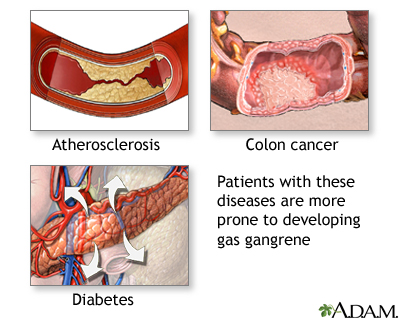
Gas gangrene develops suddenly. It usually occurs at the site of trauma or a recent surgical wound. In some cases, it occurs without an irritating event. People most at risk for gas gangrene usually have blood vessel disease (atherosclerosis, or hardening of the arteries), diabetes, or colon cancer.
Symptoms
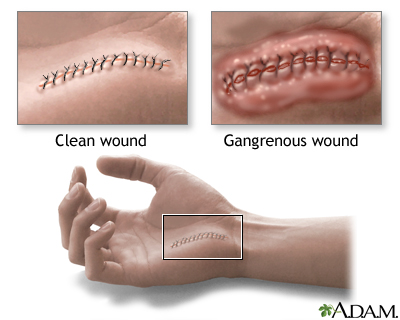
Gas gangrene causes very painful swelling. The skin turns pale to brownish-red. When the swollen area is pressed, gas can be felt (and sometimes heard) as a crackly sensation (crepitus). The edges of the infected area grow so quickly that changes sometimes occur over several minutes. The area may be completely destroyed.
Symptoms include:
- Air under the skin (subcutaneous emphysema)
- Blisters filled with brown-red fluid
- Drainage from the tissues, foul-smelling brown-red or bloody fluid (serosanguineous discharge)
- Increased heart rate (tachycardia)
- Moderate to high fever
- Moderate to severe pain around a skin injury
- Pale skin color, later becoming dusky and changing to dark red or purple
- Swelling that worsens around a skin injury
- Sweating
- Vesicle formation, combining into large blisters
- Yellow color to the skin (jaundice)
If the condition is not treated, the person can go into shock with decreased blood pressure (hypotension), kidney failure, coma, and finally death.
Exams and Tests
Your health care provider will perform a physical exam. This may reveal signs of shock.
Tests that may be done include:
- Tissue and fluid cultures to test for bacteria, including clostridium species
- Blood culture to determine the bacteria causing the infection
- Gram stain of fluid from the infected area
- X-ray, CT scan, or MRI of the area, which may show gas in the tissues
Treatment
Surgery is needed quickly to remove dead, damaged, and infected tissue.
Surgical removal (amputation) of an arm or leg may be needed to control the spread of infection. Amputation sometimes must be done before all test results are available.
Antibiotics are also given. These medicines are given through a vein (intravenously). Pain medicines may also be prescribed.
In some cases, hyperbaric oxygen treatment may be tried.
Outlook (Prognosis)
Gas gangrene usually begins suddenly and quickly gets worse. It is often deadly.
Possible Complications
Complications that may result include:
- Coma
- Delirium
- Disfiguring or disabling permanent tissue damage
- Jaundice with liver damage
- Kidney failure
- Shock
- Spread of infection through the body (sepsis)
- Stupor
- Death
When to Contact a Medical Professional
This is an emergency condition requiring immediate medical attention.
Contact your provider if you have signs of infection around a skin wound. Go to the emergency room or call 911 or the local emergency number, if you have symptoms of gas gangrene.
Prevention
Clean any skin injury thoroughly. Watch for signs of infection (such as redness, pain, drainage, or swelling around a wound). See your provider promptly if these occur.
Related Information
Necrotizing soft tissue infectionAnaerobic
Toxins
Necrosis
Vasoconstriction
Systemic
Stress and your health
Shock
Acute kidney failure
Decreased alertness
Delirium
References
Onderdonk AB, Garrett WS. Diseases caused by clostridium. In: Blaser MJ, Cohen JI, Holland SM, et al, eds. Mandell, Douglas, and Bennett's Principles and Practice of Infectious Diseases. 10th ed. Philadelphia, PA: Elsevier; 2026:chap 252.
Thompson NB. Hand infections. In: Azar FM, Beaty JH, eds. Campbell's Operative Orthopaedics. 14th ed. Philadelphia, PA: Elsevier; 2021:chap 79.
Wilcox MH, Dubberke ER. Clostridial and clostridioides infection. In: Goldman L, Cooney KA, eds. Goldman-Cecil Medicine. 27th ed. Philadelphia, PA: Elsevier; 2024:chap 271.
BACK TO TOPReview Date: 12/13/2025
Reviewed By: Jatin M. Vyas, MD, PhD, Roy and Diana Vagelos Professor in Medicine, Columbia University Vagelos College of Physicians and Surgeons, Division of Infectious Diseases, Department of Medicine, New York, NY. Also reviewed by David C. Dugdale, MD, Medical Director, Brenda Conaway, Editorial Director, and the A.D.A.M. Editorial team.
 | A.D.A.M., Inc. is accredited by URAC, for Health Content Provider (www.urac.org). URAC's accreditation program is an independent audit to verify that A.D.A.M. follows rigorous standards of quality and accountability. A.D.A.M. is among the first to achieve this important distinction for online health information and services. Learn more about A.D.A.M.'s editorial policy, editorial process and privacy policy. A.D.A.M. is also a founding member of Hi-Ethics. This site complies with the HONcode standard for trustworthy health information: verify here. |
The information provided herein should not be used during any medical emergency or for the diagnosis or treatment of any medical condition. A licensed medical professional should be consulted for diagnosis and treatment of any and all medical conditions. Links to other sites are provided for information only -- they do not constitute endorsements of those other sites. No warranty of any kind, either expressed or implied, is made as to the accuracy, reliability, timeliness, or correctness of any translations made by a third-party service of the information provided herein into any other language.
© 1997-
2026 A.D.A.M., a business unit of Ebix, Inc. Any duplication or distribution of the information contained herein is strictly prohibited.
All content on this site including text, images, graphics, audio, video, data, metadata, and compilations is protected by copyright and other intellectual property laws. You may view the content for personal, noncommercial use. Any other use requires prior written consent from Ebix. You may not copy, reproduce, distribute, transmit, display, publish, reverse-engineer, adapt, modify, store beyond ordinary browser caching, index, mine, scrape, or create derivative works from this content. You may not use automated tools to access or extract content, including to create embeddings, vectors, datasets, or indexes for retrieval systems. Use of any content for training, fine-tuning, calibrating, testing, evaluating, or improving AI systems of any kind is prohibited without express written consent. This includes large language models, machine learning models, neural networks, generative systems, retrieval-augmented systems, and any software that ingests content to produce outputs. Any unauthorized use of the content including AI-related use is a violation of our rights and may result in legal action, damages, and statutory penalties to the fullest extent permitted by law. Ebix reserves the right to enforce its rights through legal, technological, and contractual measures.
